What do you want to see?
Area · The Krk Map
Poljica, Milohnići and the Šotovento oak country
Krk's shaded inland west: a 400-year-old oak, stone-stepped village ponds, a 12th-century trefoil chapel in the woods and peka konobas worth ordering a day ahead.
Open this guide on The Krk Map
Behind the west coast lies the oak country of Šotovento: small stone villages, dry-stone walls, karst ponds and dense downy-oak and holm-oak woods that stay cool in August. The tourist board has laid out short loops between them. One leads to a 400-year-old oak with a 30 m crown and down to a swim in Čavlena bay; another links old village ponds, one with 21 stone steps down to the water; a third finds a 12th-century trefoil chapel built on a Roman villa. Afterwards, dinner is lamb or octopus from under the peka, ordered the day before. It suits families with curious children, walkers on a hot day and groups who want a long village dinner.
When to come: All year. Spring is best for the oak in new leaf and green ponds; summer mornings for shade walks. Pud Brest is open year-round; Tri Maruna by reservation only.
What to do
Walk to the 400-year-old oak and swim at Čavlena bay
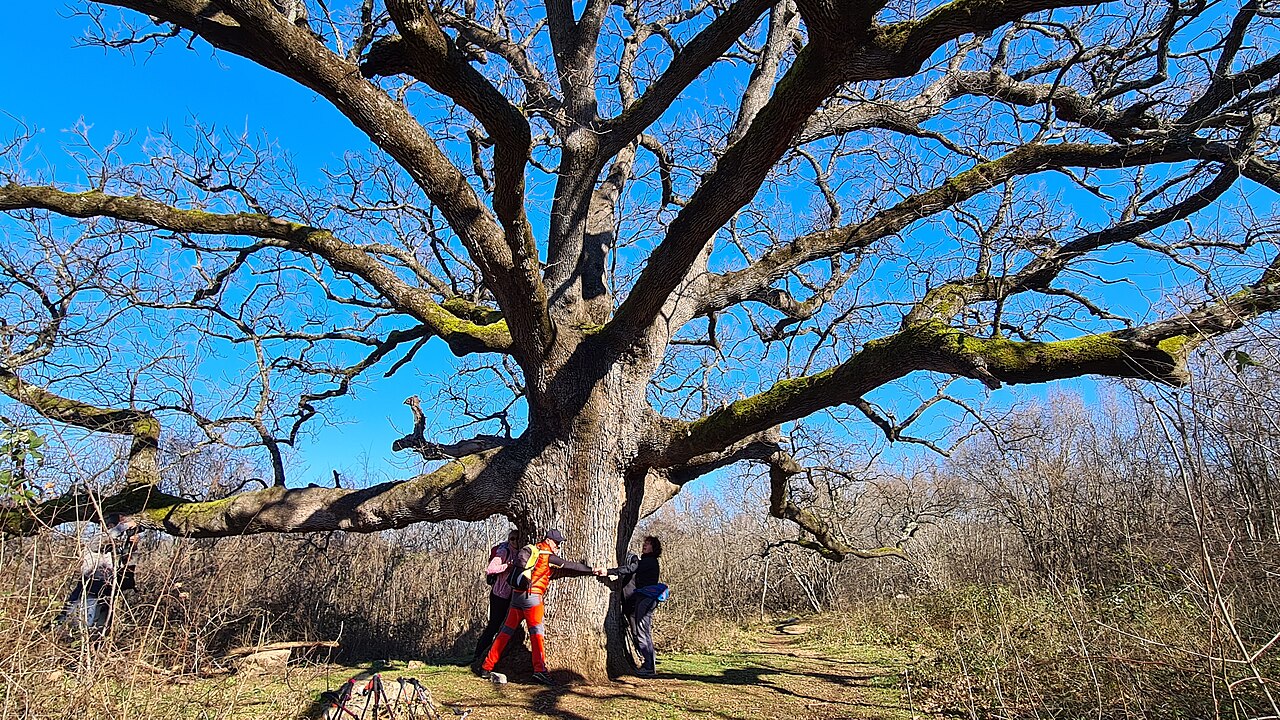
An easy 6.6 km loop with 140 m of climbing from Poljica's parish church. It follows the 'White Road' through woods and fields and down to Čavlena bay, where you can swim, then climbs steeply on a gravel track into the forest of Dolinji Drmun Puški. There stands a downy oak of about 400 years, some 20 m tall with a crown about 30 m across. The route passes two karst ponds and has views over the Srednja vrata channel to Cres.
- Where
- Start at the parking plateau by the church of SS Cosmas and Damian in Poljica.
- When
- Spring, when the oak is in fresh leaf; summer mornings for the shade and a swim.
- Time
- 2.5–3.5 hours with the swim
- How
- Tourist-board trail H128. The surface is the White Road, woodland paths and a short, steep gravel section. Free parking by the church.
Tip: Look at the church's 18th-century bell tower before you set off. Take swimming things: the swim at Čavlena comes before the climb to the oak, so the tree is your cool-down in the shade.
The Path of Ponds from Milohnići to Poljica, with 21 stone steps down to the water
An easy 6.2 km educational loop with 120 m of climbing that links the karst ponds islanders once depended on for water. It runs from the village pond in Milohnići past the drained Fintura pond (its dry-stone walls still visible), the Ormatina ponds (which hold water all year), three ponds near the ancient oaks, and Menkova and Živa lokva on the Poljica side. At Živa lokva 2, 21 stone steps lead down to the water. Information boards line the route.
- Where
- Between Milohnići and Poljica; start in either village.
- When
- Spring, for green ponds and amphibians; summer mornings. Mostly in woodland.
- Time
- 2–3 hours
- How
- Tourist-board trail H135 on woodland and field paths.
Tip: Give the children the ponds as a treasure hunt: count the ponds and find the 21 steps. The ponds are wildlife habitats, so no swimming or paddling.
Find the 12th-century trefoil chapel of St Krševan in the oak forest
A tiny Romanesque church on a three-lobed (trefoil) plan with a domed centre, built in the 12th century on the remains of a Roman country villa. Small as it is, it has the presence of a much bigger church. It stands in dense oak forest above Čavlena cove.
- Where
- Circular trail H126 from the centre of Milohnići; the chapel is in the woods north-west of the village.
- When
- Summer mornings (dense shade) or spring.
- Time
- About 2 hours (5.2 km, 170 m of climbing)
- How
- Rated medium; oak woodland paths with shorter variants.
Tip: Before or after, visit Milohnići's church of Our Lady of Health and the village pond, then book the peka dinner in the same village.
Peka night at Konoba Pud Brest in Milohnići (order the day before)
A restored stone cottage, opened in 2011, with a fireplace and a vine terrace. Lamb, veal or octopus are cooked under the peka (an iron bell under embers) and need a day's notice. Other dishes include gnocchi with goulash, homemade sausages and steak with chard potatoes, with the house olive oil.
- Where
- Milohnići 41.
- When
- Dinner; open all year, 11:00–22:00.
- Time
- 2.5 hours
- How
- Phone +385 51 862 111 the day before to order the peka. A car is needed.
Tip: Ask for the price per portion when you order the peka, and buy a bottle of their oil on the way out. Watch the sunset at Glavotok first.
For a villa group: a private peka night in Tri Maruna's vaulted cellar
An agrotourism konoba in Poljica with a four-metre vaulted cellar and grill platters under old chestnut trees. Since 2024 it opens only by reservation, for groups of five or more. Octopus under the peka is on its menu, and squid and shrimp under the bell are available on request, with walnut rakija to finish.
- Where
- Poljica 17.
- When
- Group dinner, all year, by reservation.
- Time
- 3 hours
- How
- Book ahead (+385 98 164 7106 / +385 51 861 156) and pre-order the peka. There are no walk-ins.
Tip: Ask for a group menu and price when you book.
A half day here
- 08:30: park by the church in Poljica and walk the great-oak loop (H128): White Road, a swim at Čavlena bay, then the climb to the 400-year-old oak in the shade.
- 12:00: picnic or lunch; a short afternoon rest.
- 17:00: short walk to the St Krševan trefoil chapel from Milohnići, or the Path of Ponds with the children.
- 20:00: peka dinner at Pud Brest, ordered the day before.
Where to eat and drink
- Konoba Pud Brest: Stone-cottage konoba known for its peka; order a day ahead.
- Konoba Pizzeria Ivinčić: Metre pizza for families, 10 minutes south.
Where to swim
- Poljica's 400-year-old oak and Čavlena bay: Čavlena bay, reached on the oak loop.
- Glavotok monastery coves: Friary-harbour bays and snorkelling coves, 10 minutes west (see the guide to the wild west coast).
Practical
Parking
Free lot by the church in Poljica and free parking by the Trgovina Krk shop in Milohnići.
Shops and water
Milohnići has a small Trgovina Krk grocery. There is no water on the trails, so carry it; the ponds are not drinkable or swimmable.
Seasonality
The walks work all year and are best in spring. Pud Brest is open all year. There are no cafés on the trails.
Watch out
- Peka must be ordered a day ahead; agree the price per portion at the same time.
- Bring cash: not every village konoba here takes cards.
- The ponds are wildlife habitats: no swimming or paddling.
- There is a short, steep gravel climb on the oak loop, and summer heat on the open White Road sections, so start early.
Curated by Benjamin Haller and our guests · Facts checked 31 Oct 2026 · How this map is made
The Krk Map is made by Marim Luxury Villas, a family company that hosts guests in Stara Baška and Vrbnik. No place pays to be on it; partners and our curators’ own offers are marked. Our villas